Showing posts with label The Classics. Show all posts

Friday, March 23, 2012

"First you make a roux": How to Make the Best Roux for Crawfish Etouffee

The classic start to the best Cajun dishes. 
There may not be a more debatable topic in Creole coking than the infamous roux. Each Southern chef has a different opinion on which is the best technique, color, and flavor. There are a myriad of roux varieties ranging from a "white roux" to the "brick" version and everything in between, blonde, brown, peanut butter or chocolate. Each imparts a different hue, thickening power, and distinctive nutty flavor to your dish. Making a roux is easy, burning it is easier, and mastering it is an art form.

The roux calls for 2 simple ingredients: flour and any type of fat. The choice in fat is yours, but the traditional French recipe calls for butter.  Southerners use bacon grease, lard, clarified butter, any meat fat or oil for their roux. The French use an equal ratio of fat to flour. For my roux I use a blend of fats at the ratio of 2:1 (butter/bacon grease to flour) and prefer the peanut butter hue, but again the choice is always yours. The best part of making a roux is that you can experiment and create a secret recipe which makes all your dishes unique to you.

Crawfish Etouffee 
The key to a perfect roux is to stir, stir, stir! I can not emphasize this enough, cast iron (the only place to make a roux in my opinion) holds heat so keep your pan on low and stir the hell out of the thing with a flat wooden spoon (Southerners often have a flat wooden spoon especially for roux). If you start to see any black specs, your roux is burning and at that point there is no way to save it. Toss it, wipe out your skillet, and start again. It may take you a few tries but you'll get it. Once you perfect your own unique roux, you can officially call yourself a Southern chef. Well...maybe.

Ryan stirring the pot. 
The following dish is brought to you by the official Pastorek crawfish boil. I'm lucky enough to have crawfish flown out to Los Angeles a few times each season, but if you don't have access to live, fresh Louisiana crawfish, you can easily substitute boiled shrimp.  Don't you dare use foreign imported crawfish, that's a sacrilege. Laissez les bon temps ROUX-le ya'll!

MiddleBar Crawfish Etouffee
1 lb boiled crawfish (Thanks Ryan)
1 red bell pepper (green is traditional but I hate green bell pepper)
1 small yellow onion diced
2 ribs celery diced
1 can rotel diced tomatoes
3 cloves of minced garlic
2 sprigs of thyme whole on stem
3 bay leaves
1/4 cup chopped parsley
1 tbs tomato paste
1/4 cup flour
1/2 cup butter
1 tsp bacon fat
1 tsp worcestershire
2 cans chicken stock (fresh stock if you have it)
1/2 cup water
Tony Casherie's Original Creole Seasoning, salt, pepper (about 1 tsp-1tbs depending on the saltiness of your crawfish so add seasoning as necessary)
1 large cast iron skillet

First you make a roux by melting the bacon fat, butter adding the flour and stirring until the roux takes on a nice peanut butter color. Add the onion, celery and bell pepper, salt, pepper and Tony's and saute in the roux until soft. Add garlic, rotel, worcestershire, chicken stock, water, bay leaf, and thyme and bring to a boil.  Reduce to a simmer and cover for 20-25 minutes. Remove the lid, add crawfish, and simmer for 10-20 minutes more. Remove bay leaves and thyme. Serve over heaping white rice and garnish with fresh parsley.

Friday, March 16, 2012

When Irish Eyes Are Smiling: The Irish Julep

Jameson's Irish Julep 
A St. Patrick's Day Limerick:

Two hundred and twenty years ago
In the hills were the green grass does grow.
Whiskey was in pots.
For Irish not Scotts.
And I thought that you might like to know.

Ok, so I might need to work a bit on my poetry, but you get the idea. The Irish have been distilling whiskey (and consuming it heavily) since the twelfth century and it's history is forever tied to Catholicism. Christian monks brought distillation as well as Christianity to the Druid community in Ireland.  St. Patrick was influential on the Christianity front but I can't officially say that he was distilling whiskey. He was however, according to legend, busy banishing snakes from Ireland, and comparing three leaf shamrocks to the, Holy Trinity.

Over 1300 years later John Jameson the Father of Irish Whiskey began distilling in Dublin and has been producing his high quality, triple distilled product for the last 220 years. St. Patrick's day has been commemorating the religious feast of St. Patrick since the 1600s and over the years it has become famous as a day to express your Irish identity. Not Irish? Don't worry!  John Jameson nor St. Patrick was actually born in Ireland either and they are considered two of the most famous Irishmen. Tomorrow feel free to cash in of all the "Kiss Me I'm Irish" kisses you can, you're just about as Irish as Pat & John!

The Celtic Highlanders of the Irish Channel, NOLA. 
The Irish Julep 
3 oz Jameson Irish Whiskey
1 oz Simple syrup
1/2 oz distilled water
5 fresh mint sprigs
7 mint leaves

Gently bruise 7 mint leaves with the simple syrup in a highball or julep glass. Add 1 1/2 oz Jameson, fill glass to the brim with finely crushed ice. Swirl with barspoon until the outside of the glass frosts. Add remaining bourbon and more ice. Stir again, garnish with plenty of fresh mint sprigs and serve with a short straw so that you get a nice whiff of mint each time you take a sip.

Erin Go Bragh Ya'll!

Wednesday, February 29, 2012

In South Louisiana we call that lagniappe

Thirty days hath September, April, June & November. All the rest have thirty one, except for February which sometimes, every fourth year except for centennial years has 29 days...I mean REALLY!??!?  It's a good thing that leap year only comes around every four years because it's by far the most confusing of all the holidays.

The purpose of leap year is to properly align the solar year with the calendar year which keeps all the seasons in place. If you feel the need to delve into all the mathematics behind leap year by all means click here. It's incredibly boring so I recommend having this cocktail first.

Our drink today was created by Henry Craddock for the Leap Year celebrations at the Savoy Hotel on February 29th, 1928. It is a light and lovely top shelf gin sour with a dash of sweetness from the Grand Mariner and Carpano Antica. This drink is so tasty you'll want to drink it 366 days a year.

2 oz Nolet Silver Dry Gin
1/2 oz Grand Mariner
1/2 oz Carpano Antica
1/4oz lemon juice

Shake with ice and serve up with a lemon garnish.

It's a lagniappe day Ya'll!

Tuesday, February 21, 2012

Mardi Gras 101: The Fat Tuesday Herbsaint Frappe

Mistick Krewe of Comus 1856. Known as the krewe
"that saved and transformed Creole Carnival"
It's just a Tuesday for most of us throughout the country, but my fellow New Orleanians are celebrating. Today is Fat Tuesday and  there's way more to Mardi Gras than just getting drunk on Bourbon Street.

Fat Tuesday is the final day of the Carnival Season rooted in the rich French Catholic history of New Orleans. Mardi Gras has been celebrated in Louisiana since the 1600s. Many Mardi Gras traditions such as masquerade balls, parades, and krewes (the parade organizations) that are still around today have been running annually since the mid 1800s.

Louis Armstrong & the King of Zulu
The first African American Orginization
created in 1909.
Fat Tuesday as it's so lovingly referred to, is the final day of the carnival season.  The season began on the Feast of the Epiphany (January 6th) and culminates on the day before Ash Wednesday, the beginning of Lent. In Catholic tradition, Lent is the 40 day period of reverence and fasting before Easter Sunday. Basically New Orleanians took that as a cue to eat (hence the fat), drink, and party it up before everyone had to behave. 

Today in celebration of Mardi Gras we will imbibe a classic and distinctly New Orleans cocktail the Herbsaint Frappe. Herbsaint, an anise flavored liqueur, is the creation of two New Orleans natives J.M. Legendre and Reginald Parker. These two fine young gentlemen learned the process of distilling absinthe in France during World War I. When they returned to the states, they perfected their "legal" creation by imparting the flavors of absinthe but without the illegal wormwood. (I won't mention that this "legal" version of absinthe, was still illegal under US law until December of '33) Herbe sainte is the French Creole word for the sacred herb Artemisia Absinthium. Herbsaint can be used in any cocktail that calls for Absinthe or Pastis and if you're really brave you can try your Herbsiant frappe-ed.

Herbsaint Frappe

The Herbsaint Frappe (from Nola.com)

2 oz Herbsaint Liqueur
2 oz Water or Fever Tree soda water
1 tsp simple syrup

Combine ingredients in a large glass filled with cracked ice. Stir vigorously until well frosted, then strain off the liquid to remove the ice. Return the drink back into the frosted glass and serve. This drink has an extremely strong anise flavor...you have been warned.

Happy Mardi Gras and I hope you get out there and enjoy some good p-rades. If you're like me, missing some Nawlins, you can watch the action live from the Fat Harry's Parade cam: Click Here #paradecam

Laissez les bon temps rouler Ya'll!!!


*Henri Schindler, Mardi Gras Treasures: Invitations of the Golden Age

Wednesday, February 15, 2012

Taqueria Corona: Cebollitas Fritas

The cuisine of New Orleans is incredibly diverse so finding a good meal is easy to come by. An authentic Mexican restaurant however, is much more difficult to find. Taqueria Corona filled that void in 1988 when Roberto Mendez introduced authentic, delicious, and inexpensive Mexican food to New Orleanians. Mendez's 10 seat cafe grew to a group of successful restaurants over the next 20 years and offers diners a diverse Mexican experience.

The menu features the usual enchiladas, tacos, and burritos but delicacies like pork, chorizo, and even tongue mingle among the usual chicken and beef. Queso fundido, arroz con leche, and flauta dulce can also be found, but the dish I find the most unique is cebollitas.

Incredibly simple, cebollitas are grilled green onions served with salt and lime. Thats it. It's a dish that I look for in every Mexican joint I visit but I've yet to find it (even here in California). Cebollitas are a great appetizer, side dish or even as a garnish. Enjoy this spicy, salty version at your own mexican fiesta! Ole!

1-2 large bunches of green onions (about 30 onions)
3 tsp vegetable oil
3 tsp lime juice
1/2 tsp salt
1 tsp crushed garlic
juice of 1 lemon
1 pickled jalepeno (halved)
1 tsp jalepeno pepper juice (from can)
1 large piece of heavy duty aluminum foil

Line a shallow sheet pan with one piece of foil toss all the ingredients together and fold the ends of the foil together to create a sealed foil envelope so that the juice can not escape and that steam will build up around the onions.

Broil on high for 35 minutes. Unwrap the foil pocket exposing the onions (be careful when opening the foil as hot steam will escape). Add one pat of butter to the onions broil open for 5-10 minutes more until a desired char is achieved. Sprinkle with additional salt and garnish with lime.

Arriba Ya'll!

Sunday, February 5, 2012

Superbowl Hot Wings

MiddleBar Hot Wings
It's Superbowl Sunday and you NEED wings for the big game so here's the quick and easy way to do it to wow all of your friends at half time!

How the hot wing caught on as a football snack still boggles my mind considering you're usually covered in sauce. As long as you have a couple of napkins and a cold beer close by, the game just seems more interesting with wings. The history of the Buffalo Wing has been debated for almost 50 years but I stand by the New Yorkers who believe this is the true story:

The hot sauce covered chicken wing was originally created by Teressa Bellisimo at the Anchor Bar Restaurant in Buffalo, NY. Teressa was the mother of the head bartender Dominic as well as the in house chef. The story, according to the Anchor Bar, is a “kitchen sink” recipe like the nacho and the Caesar salad created for hungry partons when the cupboard was bare. Teressa threw some chicken pieces intended for stock into a fryer and covered them in a secret sauce. The bar flies loved them and soon the wing took flight and crowds flocked to Buffalo for Teressa's Buffalo hot wings.

Over 1.25 billion (yes I just said billion) hot wings will be consumed this Superbowl weekend so join in the fun with this quick and EASY hot wing recipe that you still have time to make!

MiddleBar Hot Wings
24 bone in wings (1st and 2nd wing pieces) de-thawed
1 bottle of Frank's RedHot Original sauce
2-4 tsp of flour
1/4 cup butter melted
1 rib of celery

Preheat your oven to 375. Place the wings on a baking sheet, cook for 35-45 minutes turning once until the chicken is 180 degrees. I like mine a little crispy so I drop them in the broiler for the last few minutes of cooking to get a  light char. Lightly dust the cooked wings with the flour. Not all the flour will be necessary, there should just be a very light dust to help the sauce stick to your wings. Too much flour will cause your wings to taste like flour so tread lightly. In a large bowl cover the wings with sauce (as much as you like) and butter then toss. Serve with fresh celery sticks.

Happy XLVI Ya'll! 

Wednesday, February 1, 2012

Carpano Antica

Carpano Antica has been gradually making it's way into the American cocktail scene over the last few years. If you haven't tasted it you should and here's why.

Antonio Benedetto Carpano was an Italian distiller in the late 1700s who paired a mixture of white wine with herbs and spices creating a product he would later call vermouth. Vermouth, from the German word "vermut" or "wormwood," is an aromatic wine fortified with grain or grape spirit. If you want to learn more about vermouth, enjoy my post: NY State of Mind from Sept. 2011 by clicking here. Carpano is classified as a digestif and is a great aid to digestion after a large meal, because after all Antica was created for medicinal purposes.

Carpano is a "premium" vermouth and as with most premium alcohols the flavor profile is extremely complex. To truly understand this complexity all you have to do is sip the Carpano over a large ball of ice. The moment the Carpano touches the ice a very strong flavor bursts from the glass. As the ice slowly melts, the dry bitter spice flavors begin to mellow and notes of chocolate, caramel, and berries begin to emerge (if you don't like the first sip, let it rest). This vermouth is fantastic in a cocktail like a  Manhattan adding a deep rich bitterness that pairs nicely with the sweetness of a soft bourbon (something like Maker's Mark is perfect).

Carpano is only sold in a large bottle and does need to be consumed in a reasonable amount of time. Since it is a fortified wine it breathes like any other wine once the bottle is opened. I treat Antica as I would a fine port, drinking it within the first few weeks of opening for maximum flavor. I find that the bottle on the shelf lasts for about a month without "turning" and refrigeration adds a about 2-3 weeks more. The best way to tell if your Carpano is still drinkable is to taste it, it definitely won't hurt you or make you ill, so try it. If you like it then drink it!

This particular drink combines the Lillet Blanc, an aperitif with the digestif Carpano so it's great before or after dinner. Garnish with the zest of a fresh lemon and Regan's Orange to further accent the citric and bitter notes of both liqueurs.

2oz Carpano
2 oz Lillet Blanc
2 dashes Regan's Orange Bitters
Garnish with Lemon

Stir all ingredients over ice and strain into a chilled wine glass. Garnish with lemon.

Delizioso Ya'll!

Friday, January 20, 2012

MiddleBar Roasted Tomatoes


Ina's Tomatoes at MiddleBar
MiddleBar is known for anything that has a tomato in it. But unfortunately, tomatoes are a summer fruit and I'm a strong believer that tomatoes can't be eaten out of season. But roasting those crappy winter tomatoes turns an almost inedible December tomato into a fantastic appetizer dish year round. These tomatoes are also a great base for an unbelievable pasta sauce or tomato basil soup and don't worry you will see those recipes in future posts.

This dish is elevated in both taste AND beauty by pairing it with Burrata cheese, an artesianal soft mozzarella cheese. Burrata comes in a little cheese "pouch" and when sliced open the creamy and stringy interior cheese is exposed. Burrata is traditionally served at room temp so don't worry about putting a milky cheese out on an appetizer tray. There are several brands of Burrata available at Whole Foods, TJs and your run of the mill grocery store but I find that the best Burratas come from speciality cheese stores. I encourage you to find one in your neighborhood and spring for the more expensive cheese for this dish because you know that's the way Ina would do it.

MiddleBar Roasted Tomatoes
12-15 roma tomatoes cut in 1/2 cores and seeds removed
Olive oil
Balsamic vinegar
White granulated sugar
Salt and Pepper
Crushed garlic (I use the jar version but don't tell Ina)

Preheat the oven to 450.
Oil a half sheet pan and place the tomato halves face up on the baking sheet. Brush each tomato with crushed garlic and drizzle with olive oil and balsamic. Sprinkle with salt, fresh ground pepper and sugar. (I find that the more sugar the better, my grandfather was from Palermo, Italy and had a heavy hand with sugar in all of his red sauces.) Roast until the tomatoes are caramelized, about 30-40 minutes. Serve warm or at room temp with Burrata cheese (drizzled with olive oil, s&p) and crostini.

The Barefoot Contessa, Ina Garten, is my favorite chef hands down. I have a special love for Ina and she inspires many recipes that you read here on MiddleBar including these roasted tomatoes. I often take the liberty of altering Ina's recipes usually adding some New Orleans flair and even occasionally omitting some butter, gasp. All that butter is just cheating anyway.
How easy is that Ina!

Tuesday, January 3, 2012

The Clover Club Cocktail

You might expect he Clover Club Cocktail to be green but this drink takes it's name from the Men's  club in Philadelphia where it was invented. The Clover Club can be made with grenadine but the MiddleBar version uses raspberry syrup give the cocktail a softer hue and silky flavor.  Add some southern style with a sprig of mint and Peychaud's bitters.


1 1/2oz Gin
1/2oz Raspberry Syrup
1 lime
1 egg white
Peychaud's Bitters

Dry shake the first 4 ingredients. Add ice re-shake. Serve up and garnish with Peychaud's or sprig of mint.  An ounce of heavy whipping cream will make this lucky beverage a Pink Lady.

Alright Ya'll

Saturday, December 24, 2011

MiddleBar: Christmas Fix

Ok, ok, I'll stop blogging about eggs, I promise.

Buuuutttt.....

Not until after Christmas because no other beverage is tied to the holidays quite like eggnog. Since you just learned all about eggs this week, you can drink your eggnog the proper way, instead of from that crappy bottle they sell at the grocery store.

Unfortunately, I hate eggnog so there is no existing MiddleBar recipe for this classic Christmas delight. Have no fear loyal readers, I have found a recipe that I think you'll enjoy, and just for fun I've thrown in a recipe for everyone's other favorite holiday treat.....Fruit Cake!!!

River Road Recipes
Both recipes come unedited from the River Road Recipes Book the unofficial textbook of Louisiana cuisine.  This book is in every self-respecting southern cook's home and includes recipes from "How To Make A Roux" to "Squirrel Country Style" (no, I am not kidding).

The book was published by the Junior League of Baton Rouge in 1959, so the recipes found in it are a bit dated (and by a bit I mean extremely dated). It's an amazing snapshot of the southern kitchen and definitely one for your collection. I mean because really, where else are you going to find a recipe for "Jellied Guacamole Salad"?

I hope you enjoy these two recipes around the tree tomorrow morning and consider the River Road Recipes Book my gift to you!

Mrs. L. C. Kuttruff's Date Fruit Cake
8 eggs
2 cups white sugar
3 cups flour
2 tsp baking powder
2 tsp salt
3 tsp vanilla
1 tsp almond extract
8 cups nuts
1 lb candied cherries
1 lb candied pineapple (cut up)
2 lbs pitted dates

Set oven at 250 and grease and flower loaf or tube pans. Beat eggs together. Add sugar slowly, then 2 cups flour, baking powder and salt, which have been sifted together.  Add flavoring. Use other cup flour to flour fruit and nuts. Then add to cake mixture. Pack in lined, greased, and floured tins. Bake 2 1/2 hours at 250 with pan of hot water in oven under cake. Leave fruits and nuts in original pieces except for pineapple.


Mrs. Ralph Pearlman's Eggnog II
1 dozen eggs
1 quart of cream
1 1/2 cups sugar
1 pint whiskey
Separate eggs. Beat yolks and add sugar until creamy.  Add whiskey slowly.  Add whipped cream and stir well.  Whip half of the whites (6) and add to the above mixture by folding them. Chill well. Serves 12-14.


MiddleBar wishes you a Merry, Merry Christmas Ya'll!

Monday, December 5, 2011

Prohibition 75 years later

Today marks the 75th anniversary of the repeal of Prohibition the ridiculous 18th Amendment to the US Constitution that intended to keep our country “dry” from the sale and consumption of alcohol. The evil firewater was blamed for a multitude of sins that the American public committed and for 7,302,204 minutes from January 17th 1920 until December 5th 1933 liquor did not touch the lips of one American citizen and everything was rosy... Well at least that’s what the Temperance Movement had intended. 


If you haven’t watched Ken Burns documentary on Prohibition you should, it was fantastic. But if you are never going to get around to watching all 5 ½ hours of it don’t worry because I did and here’s basically what you missed:

According to a bunch of rural religious folks living in small towns throughout the country there were too many drunks destroying American society. They thought that if alcohol was prohibited the country would be restored to order.  Much to the dismay of  urban dwellers the 18th Amendment was passed which banned the sale and consumption of alcohol. 


People kept on drinking and states struggled to enforce the new regulation. Organized crime skyrocketed to keep up with the high demand for liquor. . The country went on a 5071 day bender drinking bathtub gin provided by gangsters in the shadows of speakeasies and the 1920s roared! Slowly people began to realize that the law created to clean up the country was actually corrupting it further. Oops. 

Finally on this fateful day 75 years ago everyone finally admitted that Prohibition was a total flop and passed of the 21st amendment nullifying the 18th.  Today we raise our glasses to one of our country’s biggest faux pas. So celebrate your inalienable right to cocktails today and enjoy Ya'll! 


Saturday, October 8, 2011

Up, up and away!


A girl walks into a bar…and thinks what’s the deal with all those random, unrecognizable  bottles of booze behind the bar. Where’s my Stoli Raspberry? Can’t a girl just get a cosmo? If you’re jonesing for cosmo, or anything called a ______-tini, go to the Cheesecake Factory. If you’re curious about those crazy bottles behind the bar of some of the coolest new spots in town, here’s a beginners guide to help you navigate that weird European terrain.

With the rise of the classic cocktail Maraschino (marr-e-skee-no) Liqueur and it’s fellow friends like Chartreuse, Dubonnet, and Absinthe are making a huge comeback. Growing up in New Orleans I had seen Maraschino gathering dust behind the bar in some prehistoric hotel. The graceful green bottle is wrapped with a raffia label and looks like something antique and I certainly had never owned a bottle of it. Since the bottle literally lasts forever, (no really, the Luxardo company claims the shelf life of Maraschino is “indefinite”), I went ahead and added it to Middlebar’s collection.

The first taste of Maraschino was overwhelming and to tell you the truth kinda tart and overly sweet.  You could just taste the Italian herbal flavors. It reminded me of Italian sweet vermouth with a fruit rather than liquorice flavor. That’s when it hit me! This must have been the secret ingredient that the head bartender at Tony Angelo’s put in the best Manhattan I’d ever drank! (the Manhattan which features Maraschino)

French and Italian liqueurs have been around for centuries so they are obviously doing something right, but here’s the deal: they are sometimes disgusting even to the advanced palate (yep I said it). Maraschino is the least offensive of them all and it blends really well with anything from gin to bourbon, cooking, and fruit salads (see future Middlebar posts).

This 750ml bottle at ¼ oz at a time is gonna take you 101.4 drinks to use up that bottle, so why not branch out and try Maraschino’s most famous cocktail the Aviation.

The Aviation is a classic cocktail from the early 20th century created in New York at the Hotel Wallick.  The original cocktail called for 1/4 oz of Crème de Violette Liqueur that turned the cocktail a pale sky blue color, hence it’s name. When the Aviation first appeared in print in the Savoy Cocktail Book in 1930 the Crème de Violette was omitted but the cocktail kept it’s name. 

Crème de Violette is easy to find these days in most upscale liquor stores but as Savoy states is not necessary to create a tasty drink.  The Maraschino and the Aviation may not appeal to the Cheesecake Factory crowd due to it’s potent flavors, but for those who’d like to try something different this is one’s a true classic!

The Aviation Cocktail
2oz Beefeater Gin
1/2 oz Luxardo Maraschino Liqueur
1/2 oz fresh lemon juice

Shake vigorously with ice, strain into a chilled cocktail glass and garnish with a flaming orange zest or a lemon twist.

Take off Ya’ll!

Friday, September 23, 2011

The Professor and his Blue Blazer

In order to better understand the history behind many of the drinks I describe in this blog, I feel that it's important for you to know a little about the man who made it all possible, a man we call, The Professor.

Jeremiah P. Thomas was born in 1830 in Sacket’s Harbor, New York, a small port town on Lake Ontario.  Documentation of Thomas’ birth date and information on his youth is a mystery (much like Jesus) but instead of attending the Naval Mathematics School in his hometown, Jerry traveled to Connecticut to study bartending before becoming a sailor.  By 1848 the young Thomas headed west for gold and instead of mining for it, he mined the 49ers.  Why spend all day in the hot sun panning for gold when you could be slinging swill to the thirsty 90,000 gold seekers?

Thomas made a fortune during his years in San Francisco amassing wealth upwards of $16,000 (the equalivent of $300,000 today) With all that cash, Thomas had the opportunity to travel back East and spend (which he did well on women, ponies, and God knows what else) before opening his first bar under Barnum’s Museum in New York city.   A few years later as David Wondrich explains in his book Imbibe, Jerry embarked on an sporting journey across America and as far as London, tending bar at different establishments along the way.  

Thomas had style and a whole mess of talent. His flashy diamond cufflinks and solid silver bar tools were only part of his bottle juggling while tossing flaming drinks from glass to glass show. (The Blue Blazer was Thomas' signature drink, see below).  Thomas picked up the nickname “The Professor” due to his extensive knowledge of spirits and his ingenious concoctions and is still considered America’s most famous bartender. 

Thomas’ greatest contribution to modern mixology is The Bartending Guide, otherwise known as, How To Mix Drinks or The Bon Vivant’s Companion (the book was published under all 3 titles).  Similar books had been produced in Europe prior to Thomas’ 1st edition in 1862 and thousands have been written since.  It's important to note that Jerry broke the mold back in the day when he compiled all the knowledge from his extensive training and traveling into one American encyclopedia. 

After publication, Thomas opened his own famous bar on Broadway between 21st and 22nd with his brother George.  The bar itself was grand success but Thomas’ champagne tastes, and penchant for gambling caught up with him and even though the bar still had patrons, Thomas was forced to close it's doors. He sold the bar on Broadway, always threatening to open a new venue, but unfortunately never did. Thomas died of an apparent heart attack in 1885 at the age of 55 two years before the 3rd edition of his book was released.

The Professor left an amazing history in the pages of his guide book. Had it not been for Thomas’ willingness to break the bartending code and compile every beverage of the age into one volume, many of our most famous American cocktails would be lost. Thanks Jerry!!

The Blue Blazer
(Taken from David Wondrich's Imbibe, click here for an awesome video of David rocking out this drink)
(READ THIS DISCLAIMER BEFORE TRYING)
I have not ever tried to create my own Blue Blazer because I'm pretty certain that my landlord would not be pleased if I set the whole place on fire (this also the reason I don't distill my own liquor so, don't do that either!!) But if you are brave enough, feel the supreme need to show off, and have a fire extinguisher handy, here is the recipe for the Blue Blazer.

2 silver plated mugs with handles
2 oz Scotch Whiskey
1 1/2 oz Boiling Water

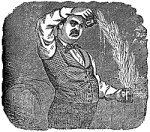
Put the whiskey and the boiling water in one mug, ignite the liquid with fire, and while blazing mix both ingredients by pouring them four or five times from one mug to another as represented in the cut.  If well done, this will have the appearance of a continued stream of liquid fire.

Sweeten with one teaspoonful of pulverized white sugar, and serve in a small bar tumbler, with a piece of lemon peel.
Source: Jerry Thomas, 1862

It's a very, very, VERY cool drink to make , but don't blame me if you burn your house down!!!!!!!

To Jerry Ya'll!

Tuesday, September 13, 2011

The Florodora Girls & Their Cocktail

Florodora was a smash hit on Broadway in the summer of 1900. A double sextet of sexy Floradora chorus girls (see below for 1900s “sexy”) and dapper young gents wowed audiences for a record setting 552 curtain calls.  This fun filled musical comedy was well loved by the smart and trendy Broadway spectators of the day so it’s appropriate that there is an equally fashionable and fun cocktail in its name.

The Floradora is a great drink in your arsenal because of it’s quirky history and fruity, charming flavor. And although these drinks go down easy they pack a punch. So beware, your once flirty girl will turn into a devil woman the morning after if you happen to overindulge on this beverage.

MiddleBar uses Hendrick’s Gin because of the rose and cucumber flavors that are blended along with the juniper berries in distillation (Floradora’s plot line is about phrenology and perfume manufacturing so it seems appropriate that roses are included).  I’ve used Bundaberg Ginger Beer in this recipe but in a pinch you can even get away with good ginger ale. The raspberry syrup can be made fresh by adding more sugar to a raspberry puree and reducing it.  But specialty markets and liquor stores often carry bottled raspberry syrup that works just as well.
Glassware: Highball, Collins glass or mason jar

Ingredients: 
1 ½ Hendricks gin
½ oz raspberry syrup
½ of 1 fresh lime

Stir with a long bar spoon until icy cold and serve.

Garnish: The traditional Florodora was garnished with a cherry and a slice of orange, but a simple lime wedge and some fresh raspberries are perfect.

Notes on Execution: This drink can be made in the glass that it is served in and requires no shaking. (remember the martini and our gentle gin). You can also make an “Imperial” Florodora by substituting the gin for Congac, Chambord for the raspberry syrup and Champagne for the ginger beer (in this version skip the lime and the stirring and garnish with a twist).

Bring the Florodora girl your next party and she’s sure to be a smash hit. Your guests will beg for an encore!

Enjoy Ya’ll!

Friday, September 9, 2011

New York State of Mind: Manhattan Cocktail

In 1964 United States Legislation officially named Bourbon America's native spirit.  This weekend is a very important one for our country and especially for New York. With those thoughts in mind, I think it's appropriate that we discuss the Manhattan. 

Any discussion of the Manhattan (or the Martini for that matter) should start with vermouth.  Vermouth, from the German word “wermut” or “wormwood,” is an aromatic wine fortified with grain or grape sprit.  Like absinthe, vermouth in its infancy was made with wormwood but after the illegalization of this powerful substance, vermouth makers quietly removed its namesake from the recipe and just stuck with grape juice, herbs, roots and flowers. 

Vermouth comes in two distinct styles, the Italian sweet, red variety and the dry white French type.  Originally vermouth had its own cocktail consisting of vermouth, ice and a twist which was a common hangover cure or a drink for those who did not enjoy the strength of hard liquor. Perhaps the vermouth drinkers wanted more kick or the hard liquor drinkers wanted less because by the mid 1860s vermouth had found it’s way into many fashionable cocktails. The Manhattan is one of the original cocktails to feature vermouth even though the Martini eventually made it famous. 

The Manhattan is obviously a New Yorker, but when and where the drink was actually created is often argued. Was it Winston Churchill’s mother at the Manhattan Club? Or a man named Black on Broadway? No one really knows, but one thing is for sure, when the New Orleans Times-Democrat Newspaper in 1885 called it “a juicy and delicious compound” they were right.

MiddleBar Manhattan

Glassware: Served on the Rocks or Up

Ingredients:
2 oz Bulliet bourbon or rye
¾ oz sweet vermouth
1 bar spoon Maraschino liqueur
3 dashes of bitters

Shake well and strain up or stir over rocks and garnish with a Maraschino cherry

Notes on Execution:
The original Manhattan was typically made with rye whiskey but bourbon works fine so the choice is yours. Some prefer the taste of Angostura bitters and I sometimes use Peychaud’s as a nod to the absinthe taste in vermouth’s history, but try it with orange, that’s what they historically do at the Manhattan Club.

A toast to New York...
Cheers Ya'll 

Saturday, September 3, 2011

Bond, James Bond: How To Make a Perfect Martini

Sean Connery celebrated his 81st birthday last week and to celebrate, Martini's, of course, darling.  The Martini is posh, potent, and particular just like Mr. Bond himself. Gin, vodka, shaken, stirred, dirty, wet, dry, up, rocks, the options are endless. Now there will be Martini posts in the future not only because I love and appreciate the Martini but also because there is enough information about the Martini to write an entire novel on the subject.  Today in honor of James Bond, I’ll talk about shaking and stirring. 

There is much debate on the subject of stirring or shaking and as I see it, it’s a matter of personal preference.  There are purists that believe there are some “rules” as to why you would shake or stir. The most common of those "rules" are:

Shake: Eggs and dairy (always) and sometimes juice
Stir: drinks with only spirits
Neither: anything served neat, with soda or tonic. (duh)
           
A vodka martini, as Mr. Bond would order, is best served cold.  In Russia, vodka is traditionally served ice cold (aka negative degrees Celsius) and since they’re kinda the authority on all things vodka, I’m going with them.  That being said, the most obvious way to chill any bar beverage is to shake it.  (Something chemically happens with the shaking, the alcohol, the ice, and the tin, etc. but I’m not a scientist so I’m not going into all of that). So shake the crap out of your vodka like Mr. Bond and enjoy. 

Gin on the other hand needs to be handled more gently according to the Dutch, and since they are the authority on all things gin, I’m going with them on this one. Stirring with the rear end of a bar spoon in a non-reactive glass is best for delicate handling of the gin.  This process chills the beverage slowly and doesn’t break the ice into tiny pieces thereby diluting or “bruising” the drink. Mixing in the bar glass supposedly reduces the “metallic” taste from the tin according to some. But really people, can you really taste a tin flavor, come on?!?

In either case there is no right or wrong even if the snobs tell you differently. Enjoy your Martini however you like because the “Professor” Jerry Thomas himself couldn’t make up his mind.
  
Glassware: Classic Martini glass chilled

Ingredients:
1/8th oz of dry vermouth
3 oz Hendricks gin
2 large stuffed olives

In a bar glass pour gin over the ice and stir gently for at least 30 seconds, on a hot day stir even longer.  Quickly rim the inside of your martini glass by turning the glass in your hand at a 45 degree angle coating the entirely then discard the leftover vermouth.  Strain into the glass garnish and serve. 

Garnish:
Traditionally spear 2 pimento olives although any stuffed olive will do and drop into glass. For a Gibson (my personal favorite) spear 2 cocktail onions.  For a Dewtini, add one spear on stuffed peppadew.  

Happy belated, Bond.
Enjoy Ya'll!

Thursday, August 18, 2011

Napoleon House Pimm's Cup

Want to get the “I don’t drink gin” fellow to drink gin?  Well then serve him a Pimm’s No. 1 Cup.  Most people who are drinking Pimm’s don’t even realize that they are drinking a gin based beverage because the drink is so pleasant, refreshing and almost fruity. Qualities the average drinker doesn't associate with gin. 

The Pimm’s Cup is a English specialty drink usually mixed with a lemonade, ginger ale or soda. In England this style of beverage commonly known as a “fruit” or “summer cup.” Summer cups are created by adding a special blend of herbs, spices, and fruit to a base liquor (most often gin). 

Pimm’s recipe for it’s herbal botanical concoction is a closely guarded secret known by very few in the company.  Since it’s original creation by James Pimm at his London based oyster house in 1823, the Pimm’s Company has produced several different numbered cup varieties.  Pimm’s Nos. use base alcohols of gin, brandy, and vodka but Pimm’s No. 1 is the original, the most popular, and has proven the test of time. 

The original “English” version is simple: Pimm’s No. 1, a twist of lemon, filled with ginger ale over ice.  The "New Orleans" version credits the Napoleon House (500 Chartres St.) as it’s creator.  The website gives their secret away (not that it’s too hard to figure out) and is sure to mention that theirs is still the best “...be warned, home concoctions of the Pimm's Cup, no matter how accurate, for some reason, never taste as good as those at the Napoleon House.”

The Napoleon House Pimm’s Cup

Glassware: 12 oz tumbler

Ingredients:
1 ¼ Pimm’s No. 1 Cup
3 oz Lemonade
Fill 7up soda

Garnish: Cucumber slice

Some recipe’s call for mint, oranges, ginger ale, ginger beer, soda, muddling and the like. And the possibilities seem endless in creating one’s own special Pimm’s Cup.  For this beverage MiddleBar serves the classic using fresh lemonade and often substituting Sprite for 7up.  

MiddleBar Lemonade

Glassware: 1 large pitcher

Ingredients:
4-6 large fresh lemons
3/4 cup white granulated sugar
filtered water
stir

The Pimm's cup is a wonderful treat with oysters on the half shell and better be, it was created at an oyster house!!

CheersYa’ll!


Tuesday, August 9, 2011

Somewhere over the Rainbow

Pat O'Brien's is of course a New Orleans staple.  The ambience is matched by no other.  Just spend one night at the piano bar and you'll see why.  Pat O's as it's so lovingly referred to by New Orleanians has (of course) an interesting history.

After prohibition ended in 1933, Pat O'Brien turned his then speakeasy bar into a legitimate dram house.  The cramped space in the 600 block of St. Peter's street proved to be too small to hold the bar's ever growing crowd that was expanding far beyond just neighborhood folks. So in the late 30s the business moved to it's larger location where it stands today (718 St. Peter).

In the early 1940s there was a shortage of whiskey, scotch, and bourbon as a result of war, the depression, and the drought from the years of prohibition. Rum, however was everywhere and New Orleans being the port city that it is saw plenty of it coming up the river.  Pat O's was determined to make the spirit palatable to it's clientele and thus after plenty of trial and error, the head bartender tossed his final creation into a glass shaped like a Hurricane lamp and the Hurricane was born.

Now, the Hurricane gets plenty of press but there are other cocktails on the Pat O'Brien's menu that many people are missing out on while pounding Hurricanes back watching the dueling pianos and slurring the words "You Don't Have to Call Me Darlin'...Darlin'." The cyclone, the skylab, the rain storm, are definite must try's but my personal favorite is The Rainbow.

Now I'm not usually a fan of the severely sweet cocktail in fact I tend to shy away from anything that even gives the appearance of a sugary hangover in a glass and that's blue (anything blue is just sketchy in my opinion.) But the rainbow is something different and my only exception.  And a layered drink is just cool, I mean come on, it is.

The Rainbow
(all ingredients must be layered to give this drink it's signature layered look for more about layering see tips and technique, if not your drink will just be a greenish mess with red syrup on the bottom.)

Glassware:  Pat O'Brien's serves their rainbow in a 14oz "lightning glass" and for $3.00 a piece having a nice collection of 6 is cost effective and also just fun to have. If not just grab a 14oz collins glass and if worse comes to worse, lighten up on the sweet and sour and just use a 12oz collins.

Instruction: (in the order of execution)
1 oz Grenadine
Add Ice
2 oz Vodka
Fill sweet and sour (feel free to make it from scratch but Pat O'Brien's offers it's own bottled variety)
Float 1-2 oz of blue curacao

Garnish:
A simple cherry and orange flag will top this off and you're ready to go.

It's not a fancy, superior, or trendy cocktail but it is fun and the rainbow, like Pat O'Brien's has stood the test of time. So they must be doing something right.

Have Fun Ya'll !